
STM32 Microcontrollers | STM32: STM32 Microcontrollers, STM32 is a family of microcontroller ICs based on the 32-bit RISC ARM Cortex-M33F, Cortex-M7F, Cortex-M4F, Cortex-M3, Cortex-M0+, and Cortex-M0 cores. STMicroelectronics licenses the ARM Processor IP from ARM Holdings. The ARM core designs have numerous configurable options, and ST chooses the individual configuration to use for each design. ST attaches their own peripherals to the core before converting the design into a silicon die. The following tables summarize the STM32 microcontroller families.
STM32 History
The STM32 is the third ARM family by STMicroelectronics. It follows their earlier STR9 family based on the ARM9E core, and STR7 family based on the ARM7TDMI core. The following is the history of how the STM32 family has evolved.
- In October 2006, STMicroelectronics (ST) announced that it licensed the ARM Cortex-M3 core.
- In June 2007, ST announced the STM32 F1-series based on the ARM Cortex-M3.
- In November 2007, ST announced the low-cost “STM32-PerformanceStick” development kit in partner with Hitex.
- In October 2009, ST announced that new ARM chips would be built using the 90 nm process.
- In April 2010, ST announced the STM32 L1-series chips.
- In September 2010, ST announced the STM32VLDISCOVERY board.
- In November 2010, ST announced the STM32 F2-series chips based on the ARM Cortex-M3 core, and future development of chips based on the ARM Cortex-M4 and ARM Cortex-M3 cores.
- In February 2011, ST announced the STM32L-DISCOVERY board.
- In March 2011, ST announced the expansion of their STM32 L1-series chips with flash densities of 256 KB and 384 KB.
- In September 2011, ST announced the STM32 F4-series chips based on the ARM Cortex-M4F core and STM32F4DISCOVERY board.
- In February 2012, ST announced the STM32 F0-series chips based on the ARM Cortex-M0 core.
- In May 2012, ST announced the STM32F0DISCOVERY board.
- In June 2012, ST announced the STM32 F3-series chips based on the ARM Cortex-M4F core.
- In September 2012, ST announced full-production of STM32 F3-series chips and STM32F3DISCOVERY board. The STM32 F050-series will also be available in a TSSOP20 package.
- In January 2013, ST announced full Java support for STM32 F2 and F4-series chips.
- In February 2013, ST announced STM32 Embedded Coder support for MATLAB and Simulink.
- In February 2013, ST announced the STM32 F4x9-series chips.
- In April 2013, ST announced the STM32 F401-series chips.
- In July 2013, ST announced the STM32 F030-series chips. The STM32 F030-series will also be available in a TSSOP20 package.
- In September 2013, ST announced the STM32F401C-DISCO and STM32F429I-DISCO boards.
- In October 2013, ST announced the STM32F0308DISCOVERY board.
- In December 2013, ST announced that it is joining the mbed project.
- In January 2014, ST announced the STM32 F0x2-series chips, STM32F072B-DISCO board, and STM32072B-EVAL board.
- In February 2014, ST announced the STM32 L0-series chips based on the ARM Cortex-M0+ core.
- In February 2014, ST announced multiple STM32 Nucleo boards with Arduino headers and mbed IDE.
- In February 2014, ST announced the release of free STM32Cube software tool with graphical configurator and C code generator.
- In April 2014, ST announced the STM32F30x chips are now available in full production. A new NUCLEO-F302R8 board was also announced.
- In September 2014, ST announced the STM32 F7 series, the first chips based on the Cortex-M7F core.
- In October 2016, ST announced the STM32H7 series based on the ARM Cortex-M7F core. The device runs at 400 MHz and is produced using 40 nm technology.
- In November 2017, ST announced the STM32L4+ series, an upgrade to the STM32L4 series Cortex-M4 MCUs.
STM32 Series
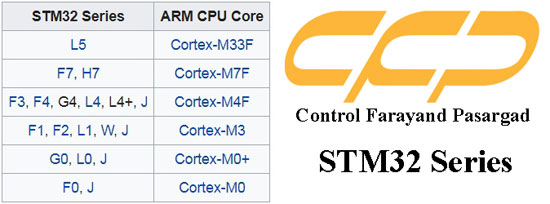
The STM32 family consists of ten series of microcontrollers: H7, F7, F4, F3, F2, F1, F0, L4, L1, L0,. Each STM32 microcontroller series is based upon either a Cortex-M7F, Cortex-M4F, Cortex-M3, Cortex-M0+, or Cortex-M0 ARM processor core. The Cortex-M4F is conceptually a Cortex-M3 plus DSP and single-precision floating point instructions.
- STM32 H7: The STM32 H7-series is a group of STM32 microcontrollers based on the ARM Cortex-M7F core.
- STM32 F7: The STM32 F7-series is a group of STM32 microcontrollers based on the ARM Cortex-M7F core. Many of the F7 series are pin-to-pin compatible with the STM32 F4-series. (ARM Cortex-M7F core at a maximum clock rate of 216 MHz.)
- STM32 F4: The STM32 F4-series is the first group of STM32 microcontrollers based on the ARM Cortex-M4F core. The F4-series is also the first STM32 series to have DSP and floating point instructions. The F4 is pin-to-pin compatible with the STM32 F2-series and adds higher clock speed, 64 KB CCM static RAM, full duplex I²S, improved real-time clock, and faster ADCs.
- STM32 F3: The STM32 F3-series is the second group of STM32 microcontrollers based on the ARM Cortex-M4F core. The F3 is almost pin-to-pin compatible with the STM32 F1-series.
- STM32 F2: The STM32 F2-series of STM32 microcontrollers based on the ARM Cortex-M3 core. It is the most recent and fastest Cortex-M3 series. The F2 is pin-to-pin compatible with the STM32 F4-series.
- STM32 F1: The STM32 F1-series was the first group of STM32 microcontrollers based on the ARM Cortex-M3 core and considered their mainstream ARM microcontrollers. The F1-series has evolved over time by increasing CPU speed, size of internal memory, variety of peripherals. There are five F1 lines: Connectivity (STM32F105/107), Performance (STM32F103), USB Access (STM32F102), Access (STM32F101), Value (STM32F100).
- STM32 F0: The STM32 F0-series are the first group of ARM Cortex-M0 chips in the STM32 family.
- STM32 G0: The STM32 G0-series is a lower power alternative to the L0 series.